40 cubic meters of high-value PCs.
Twelve custom crates. Zero retail boxes.
AMD came to us in 2024 with the opposite problem from Logitech G. Their fleet wasn't scattered - it was centralized, audited, and accounted for. What it lacked was preparation. Forty cubic meters of high-spec PCs shipping in retail packaging that was never engineered for repeat European logistics. Glass side panels cracking in transit. BIOS configurations drifting across machines that were supposedly identical. Local event teams burning the first day of every setup on unpacking foam. We didn't fix their logistics. We re-engineered their hardware delivery.
FLEET SIZE40 m³
HARDWARE TYPEHigh-value PCs + peripherals
RELATIONSHIP SINCE09/2024
CONTRACT STATUSCompleted 09/2025
THE SITUATION WE WALKED INTO · 2024
A fleet of identical PCs that didn't behave identically.
AMD's central operations team had something Logitech G didn't: actual centralized fleet management. Forty cubic meters of high-spec gaming PCs, peripherals, headsets - allocated to European events from a single source. What they didn't have was preparation. PCs were shipping in their retail boxes, fifteen per pallet, foam tooling matched to individual unit ID. Glass side panels arrived cracked because retail packaging was never engineered for repeat truck and air logistics across the continent.
The deeper issue surfaced quickly: the fleet had been in active rotation for eighteen months, and the BIOS had never been touched. PCs came back from events in unknown configurations. Nobody had reset anything. Settings drifted from one event to the next. Forty machines that were technically identical on the spec sheet behaved differently in performance and stability - and nobody on the AMD team had time to chase the inconsistency. Local event managers were burning the first day of every setup unpacking foam, then troubleshooting why otherwise-matched machines were rendering differently under load.
BEFORE BFS · 2024 · PCs ARRIVING IN RETAIL PACKAGING, FIFTEEN PER PALLET
WHAT WE DID · 2024–2025
We took ownership. The fleet rebuilt itself one process at a time.
PHASE 01 · DIAGNOSTICS & STANDARDIZATION
250 PCs reviewed, one machine at a time.
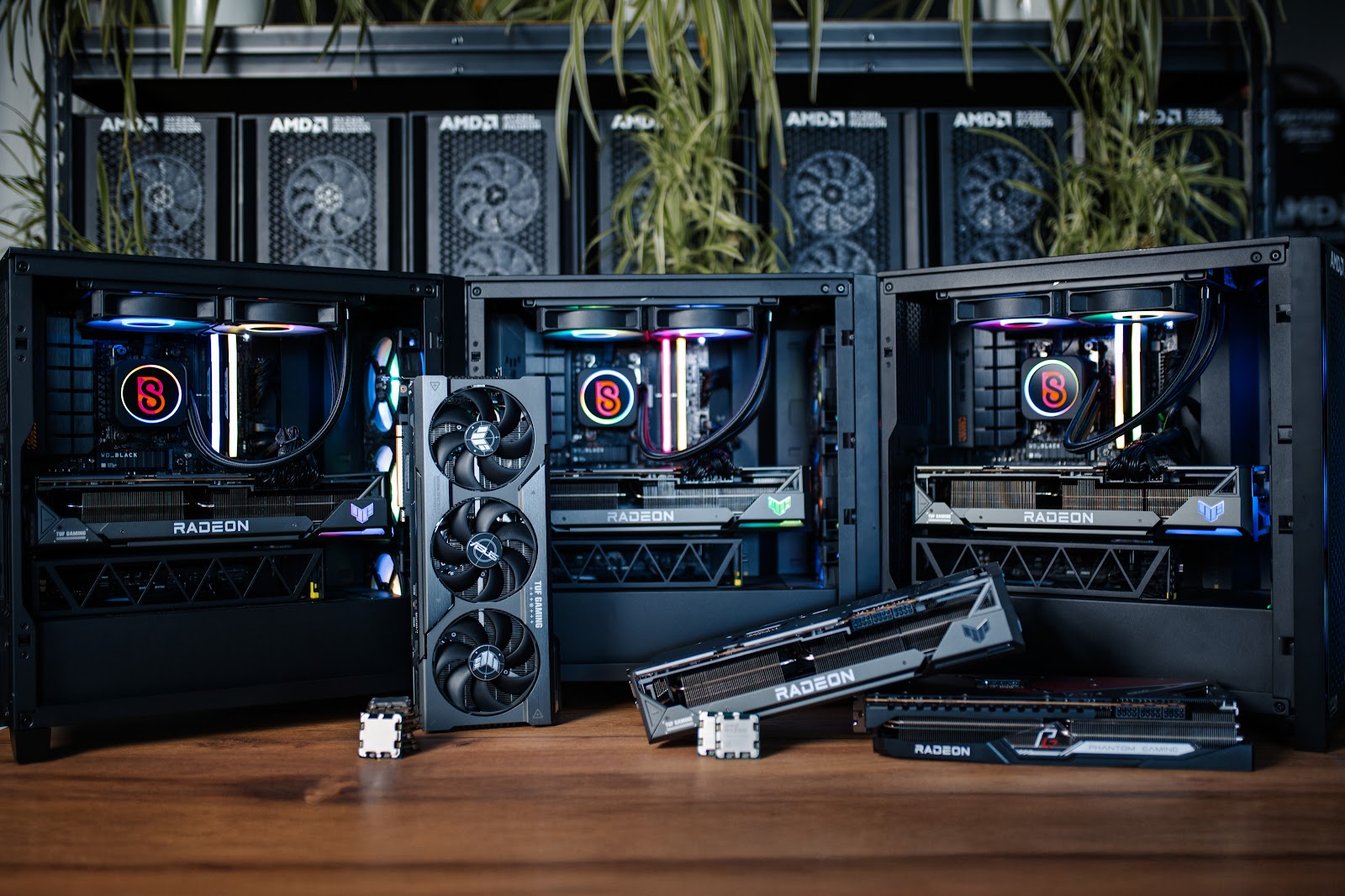
When AMD's fleet arrived at our Warsaw hub, we treated it the way we treat our own equipment. Every PC was opened, inspected, and documented - current BIOS version, memory configuration, thermal paste condition, internal packaging materials, signs of wear from previous events. The fleet had been in active rotation for eighteen months without a single touchpoint of standardization. Every machine had drifted somewhere - settings, firmware, thermal management - and the drift had been quietly degrading performance for over a year.
We worked through the fleet methodically. BIOS was updated to a single version across all 250 PCs and locked to a unified profile. XMP memory settings were enabled and validated per board. Stability tests and performance benchmarks were run on every machine. Thermal paste was replaced. Internal cardboard packaging and styrofoam fillers - left inside the chassis from manufacturer shipping - were removed permanently. By the end of this phase, the fleet was technically identical for the first time since its initial deployment.
What we recommended next, after the fleet was clean.
With the diagnostic phase complete and the fleet behaving consistently, we presented AMD with a set of engineering proposals - interventions we'd developed and tested with other clients, each requiring incremental investment beyond the baseline contract. The proposals addressed the operational pain points that the standardization phase had surfaced: 2.5 hours of per-machine software loading before each event, GPU instability under transit shock, and retail packaging that was actively damaging the fleet over time.
Three proposals went forward: SSD hot-swap bays for parallelized pre-loading at the hub, custom GPU bracing brackets for transit protection, and a complete redesign of the transport layer. AMD approved each one. Hot-swap bays and GPU bracing were installed during the next routine maintenance window. The transport crates required a longer engineering cycle and entered rotation later in the year.
PHASE 03 · FLEET IN ROTATION
From early 2025: custom crates, GPU holders, hot-swap bays - fleet-wide.
Since early 2025, AMD's entire fleet has been moving through Europe in custom transport crates with GPU holders and SSD hot-swap bays installed on every machine. Retail packaging - the cardboard, the styrofoam, the manufacturer foam tooling - has been retired from circulation entirely. The same twelve crates ship out and come back, ready for the next event, with no repacking, no foam insert matching, no per-machine reconfiguration.
The crates are designed for the full European event circuit: road freight, sea freight, air freight, forklift handling, and on-site manual handling at events. Each crate includes a dedicated bay engineered for GPS modules - the bay is prepared, the system itself is on AMD's roadmap for future investment when fleet-level visibility becomes the next operational priority.
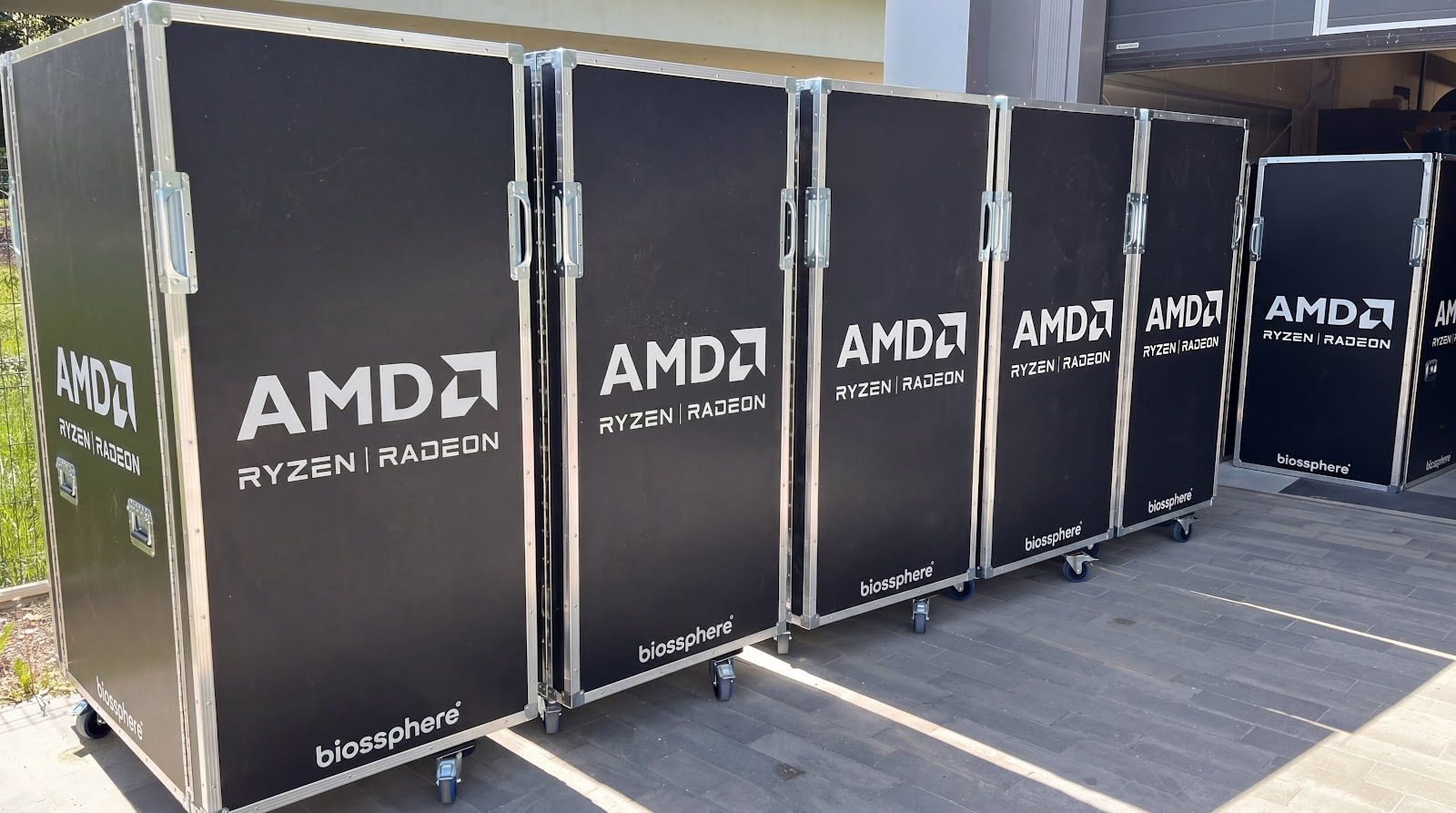
WARSAW HUB · 2024 · TWELVE CRATES, FOAM-TOOLED TO AMD'S FLEET COMPOSITION, LOADED FOR DISPATCH
ENGINEERING PROCESS · 2024
How we designed AMD's twelve transport crates.
The transport crates were the last intervention in AMD's project - added after the fleet had been diagnosed, standardized, and stabilized. By the time we started the crate engineering, we already knew exactly what AMD's PCs looked like, exactly how their peripherals shipped, and exactly which transport conditions the fleet was failing in. The engineering process below is the design path from "we know what's wrong" to twelve crates entering rotation in early 2025.
PHASE 01 · PROBLEM IDENTIFICATION · 2024 · WHAT WE TOLD AMD WAS BREAKING
PHASE 01 · PROBLEM IDENTIFICATION · Q3 2024
We told AMD exactly what their fleet was losing in transit.
Before we proposed anything, we documented what was already failing. The fleet's retail packaging had been quietly degrading the hardware for eighteen months - cardboard wear, foam compression, glass panel exposure under freight conditions. We surfaced the failure modes back to AMD with specific recommendations drawn from solutions we'd already developed and validated for other PC fleets of comparable size. The goal was clear: eliminate every cardboard box and every internal styrofoam filler from the active fleet.
One hybrid crate format. Eighteen complete event sets per crate.
We measured every dimension of AMD's PC chassis, factored in the full peripheral inventory the fleet shipped alongside the machines, and worked through the constraints that defined the final crate: international transport standards for road, sea, and air freight; manual handling weight limits for on-site event teams; protection requirements for the glass side panels that had been breaking in retail boxes. The output was a single hybrid crate format engineered to hold eighteen complete event-ready sets - PC plus peripherals - in one transport unit. AMD approved the design and the project moved to production.
PHASE 03 · PRODUCTION · 2024 · TWELVE CRATES, PROFESSIONAL MANUFACTURING PARTNER
The design specification was handed off to a manufacturing partner specialized in custom transport cases. We provided the CAD models, foam tooling specifications, and final dimensional drawings. The production run delivered twelve crates that entered rotation at the start of 2025. Each crate includes a dedicated bay engineered for a GPS module - the bay is prepared, ready to be activated whenever AMD decides to invest in fleet-level location tracking as the next operational layer.
HARDWARE LAYERS · PER MACHINE
Three engineering layers we install on every PC.
The crates protect the fleet in transit. What protects performance is what we do inside each PC before it ships. Three hardware-level interventions, applied to every machine in AMD's fleet, every time it passes through our Warsaw hub.
L01 · GPU BRACING
Static load 8 kg, shock-tested for air freight.
Custom GPU bracing brackets per card model. The bracket reinforces against the PCIe slot's lateral movement during transit and supports the card's full weight in vertical orientation. Sized per GPU height to clear the side panel without contact. Shock-tested for air freight transit profiles, validated against AMD's specific GPU mix.
Per-GPU-model fitment: Radeon RX 7900 XTX
Static load capacity: 8 kg
Shock-tested: IATA air freight profile
Installation: 10 min per PC, single-pass
L02 · SSD HOT-SWAP
2.5 hours of pre-load, reduced to 8 minutes.
Standardized SSD hot-swap bay installed in every PC chassis. Software, games, and event-specific configurations are pre-loaded onto swap cartridges at our Warsaw hub, then inserted into the PC at dispatch. The bay accepts standard 2.5" SATA cartridges and locks for transit. What used to take 2.5 hours of per-machine software loading on-site now takes 8 minutes.
Standard 2.5" SATA III cartridge format
Transit-locked, tool-free swap
Pre-load time at hub: 2.5 h per PC, parallelized
On-site swap time: 8 min per PC
L03 · BIOS STANDARDIZATION
250 PCs, one configuration profile.
Every PC in AMD's fleet runs the same BIOS version, the same XMP memory profile, the same boot configuration, and the same power management settings. The configuration profile is locked at our Warsaw hub before every event dispatch - no settings drift between events, no inconsistent behavior between supposedly identical machines. What changed for AMD: 250 PCs that used to behave differently under load now behave identically.
BIOS version: locked to AMD-approved profile
XMP memory: per-board enabled and validated
Configuration drift: zero between events
Re-validation cycle: every event return
WHAT CHANGED · LIVE NUMBERS, 2024–2026
The fleet stopped breaking. The events stopped failing.
SETUP TIME REDUCTION
>90%
Local event managers stopped unpacking foam, disposing of cardboard, and reassembling fleet IDs. Setup is now plug-and-deploy from the crate.
DAMAGE IN TRANSIT, HANDLING & GLASS PANELS
0%
Twelve months of European event circuit. Zero in-transit damage. Zero glass panel breakages. The custom crates ended retail-packaging losses entirely.
SSD PRELOAD TIME PER PC
2.5h → 8min
Software and games pre-loaded onto hot-swap cartridges at the Warsaw hub. On-site swap takes 8 minutes per machine. Eight hours of cumulative event-day prep time, eliminated.
FLEET TURNAROUND BETWEEN EVENTS
−80%
No retail-box repacking. No foam insert matching. No per-machine reconfiguration. The same twelve crates ship out and come back, ready for the next event.
PCs WITH UNIFIED BIOS · XMP · GAMING OPTIMIZATION
100%
Every PC in AMD's fleet runs identical BIOS, XMP, and performance configurations. No version drift, no inconsistent behavior, no event-day surprises.
EVENT STABILITY RATE
60% → 99%
Pre-BFS, roughly four in ten events ran into stability issues - crashes, freezes, performance drops. Post-BFS, that number is one in a hundred.
CASE STUDY 01 / 02
Read the Logitech G case study.
25 m³ of gaming peripherals across 15 markets. Consolidated into one chain of custody, paired with their dongles in advance, and made visible to their global team for the first time.
We'll review what you currently have, where it's distributed, what it's costing you, and what the path forward looks like. If we're not the right partner, we'll tell you in one call.